The pitch is hard to resist. A hundred-inch image on your living room wall, proper cinema atmosphere, a setup that makes your neighbour’s 75-inch OLED look like a tablet. And for a fraction of what a large-screen television costs, if you believe the brochure.
The reality is messier. Projectors are genuinely excellent in the right situation and genuinely terrible in the wrong one. The mistake most people make is buying on the fantasy rather than an honest look at how they actually watch things.
The case for
Start with the one thing no television can touch: size. A decent projector in a suitable room gives you a 100 to 120-inch image that a TV simply cannot match at any sane price point. A 100-inch television exists. It costs more than a car. A projector that fills the same wall costs a fraction of that, and for people who want a real home cinema, that maths is difficult to argue with.
There’s also something to be said for the experience itself. A large projected image is fundamentally different to a large panel, and for most people it’s easier on the eyes over a long session. You’re looking at reflected light rather than a screen shining directly at you. Over a two-hour film, that difference is real.
And then there’s the space argument. A ceiling-mounted projector with a retractable screen, or just a decent white wall, takes up almost nothing when you’re not using it. A television dominates a wall permanently. In a smaller living room where a big TV would feel like it was looming over you, a projector is the more considered solution.
The case against
Here’s what the projector YouTube rabbit hole doesn’t spend much time on: light.
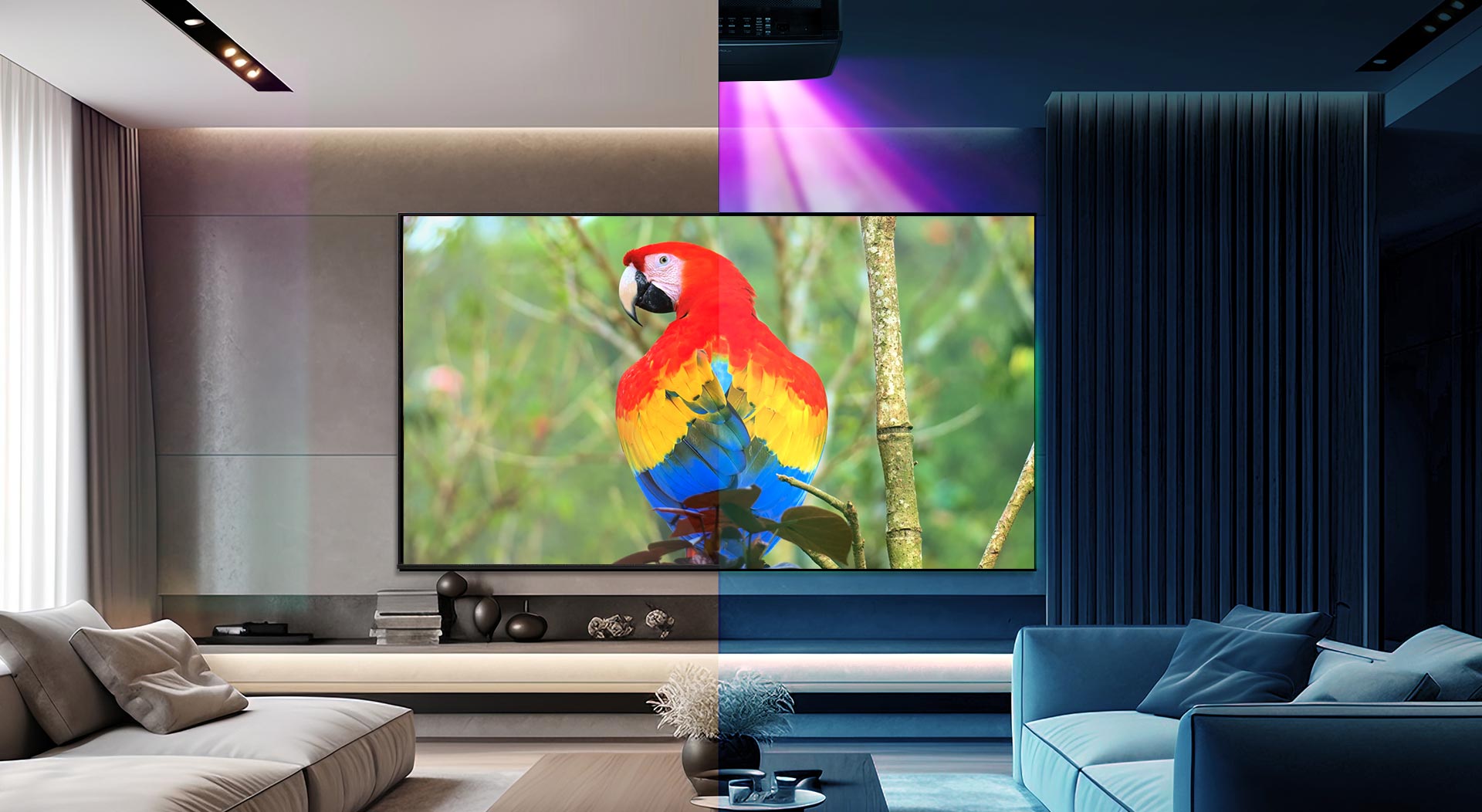
Projectors and ambient brightness are in fundamental tension. The image is reflected off a surface, which means any competing light source, a window, a lamp, an overhead light left on, will wash it out. A 4K television looks spectacular in a sunlit room. A projector in the same room at the same time looks like a faded mess.
This is the dealbreaker for most households. If your living room gets natural light during the day, if you watch sport on weekend afternoons, if someone’s on the couch at 3pm wanting to watch something, a projector will disappoint you more often than it impresses you. The cinema experience it promises is real, but it requires cinema-like conditions. Darkened room, controlled light, deliberate sit-down viewing. That’s not how most families watch television.
Beyond light, there’s the installation reality. A ceiling-mounted projector done properly means running cables through walls or ceiling cavities. That either costs money to do right or looks like a student rental if you don’t. Short-throw projectors on a shelf solve some of this, but introduce their own constraints around placement and distance.
Lamp-based projectors also have a finite bulb life, typically three to four thousand hours before brightness drops noticeably, and replacements aren’t cheap. Laser projectors have largely solved this, but they cost more upfront.
And sound. A projector makes a picture. It doesn’t make audio of any consequence. A television at least has built-in speakers, however average. A proper projector setup means a soundbar or a surround system, which adds cost to a purchase you were perhaps already convincing yourself was a bargain.
Where the technology is right now
The market has improved considerably in the last few years, and that matters.
Laser has replaced lamp-based as the sensible default for home use. Brighter, longer-lasting, no warm-up delay, and the price gap is narrowing as the technology matures. If you’re buying in 2025, laser is where you should start.
Short-throw and ultra-short-throw projectors have addressed the room-size problem. A UST unit sits just centimetres from the wall and throws a large image without needing a long dark corridor behind you. LG, Samsung, Epson, and BenQ all have credible options in the Australian market at prices that are competitive with large-screen televisions, once you’re honest about the total cost of a TV setup anyway.
Native 4K is now standard at mid-range prices. There’s still pixel-shifting in cheaper units that markets itself as 4K without fully delivering it, so reading the specs carefully is worth your time, but genuine 4K at a reasonable price is no longer the exception.
Smart platform integration has also matured. Most current projectors run Android TV or Google TV built in. The era of the projector as an isolated display device requiring a separate media player is mostly over.
Who should actually buy one
If you have a dedicated room, or a room you can reliably darken, and you want the biggest possible image for films and sport, a projector is a legitimate and compelling choice. People willing to invest in proper installation, a decent screen, and a sound system will get something no television at any price can replicate in terms of scale. That’s not hype, it’s just physics.
Renters who move regularly are also decent candidates, oddly enough. A short-throw projector and a portable screen, or a suitable wall in each new place, means you take the cinema with you. It’s more practical than it sounds.
If your viewing habits are deliberate and predictable, and you control the environment, a projector suits you well.
Where it falls apart is the shared family living room with unpredictable schedules, variable light, and the expectation that the screen is just on whenever someone wants it. The school-holiday afternoon where kids want to put something on at noon in a room with three windows is where projector ownership tips from satisfying to annoying.
The honest comparison
A 65-inch OLED sits somewhere between $2,000 and $4,000 depending on brand and timing. It’s excellent in any light, needs no installation, comes with speakers, turns on instantly, and looks genuinely beautiful. For most households, it’s the right answer, and there’s no shame in that.
A solid laser projector with a proper screen, reasonable sound, and competent installation can be put together for a similar budget, and it’ll give you an image three times the size under the right conditions. For the right household, that’s a better outcome.
The question was never which one is objectively superior. It’s which one fits the way you actually live. Be honest about your room, your light, your habits, and how much friction you’re willing to tolerate in your setup, and the answer tends to surface pretty quickly.
Projector regret is real. So is projector satisfaction. The difference is almost always just whether someone thought it through before handing over the card.