Lithium-ion Is A Blessing And A Curse
As the proud former owner of a Galaxy Note 7, I’m not exactly a stranger to Samsung’s history of battery problems. It’s hardly just them, though – modern rechargeable batteries are lithium-ion-based, making for power storage that is energy-dense enough to be potentially dangerous on very rare occasions (though sadly not energy-dense enough for many of our use cases). Various devices are going to have very occasional issues where their batteries begin to swell up as they age – and possibly even explode or catch on fire, though this is very rare. The advice for these situations is common and obvious – make sure to pay attention to how your device looks and feels so you can catch a swelling battery early, and contact the retailer, manufacturer or a third-party immediately for a repair or replacement. It sucks that we have to worry about this, but society has collectively decided that this is a worthy price to pay – and frankly I agree, compared to constantly replacing pencil batteries (look up the legendary Sega Nomad for an extreme example of that). But that’s on devices like phones or my Switch 2. A new incident from the end of September takes things a bridge too far.
What Is a Galaxy Ring?
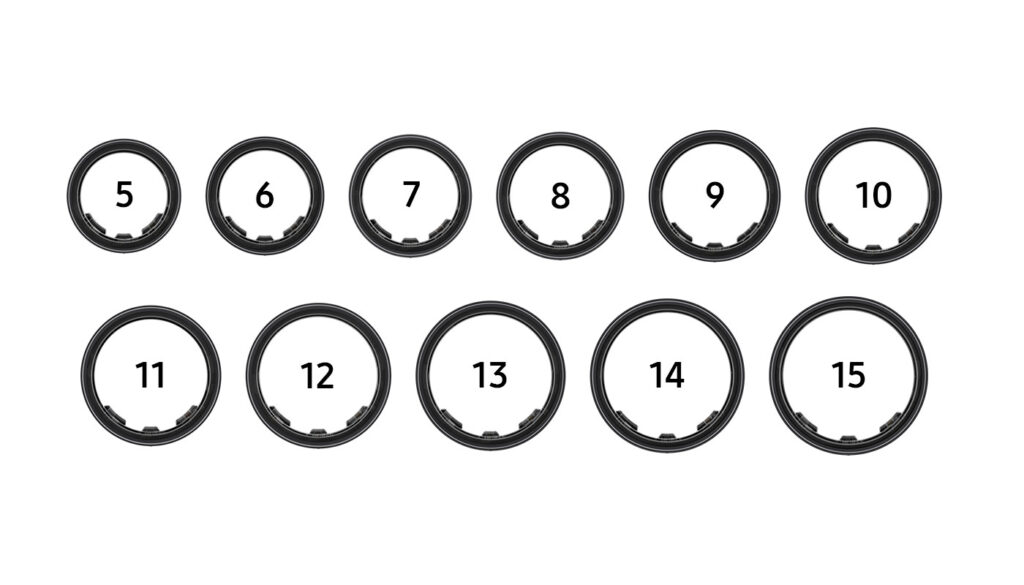
The Galaxy Ring, Samsung’s take on the “smart ring” concept, is a piece of wearable tech in the form of an actual ring. It features several of the same health and fitness tracking functions that you’d find in a smartwatch, but allows the wearer to access them without wearing something so obviously technological. This is a sensible initial pitch for some customers, but the seriousness of the situation described in the following tweets is difficult to overstate.
Electronic Device, Or Torture Device?

(Screenshots obtained from Daniel Zotar’s Twitter)
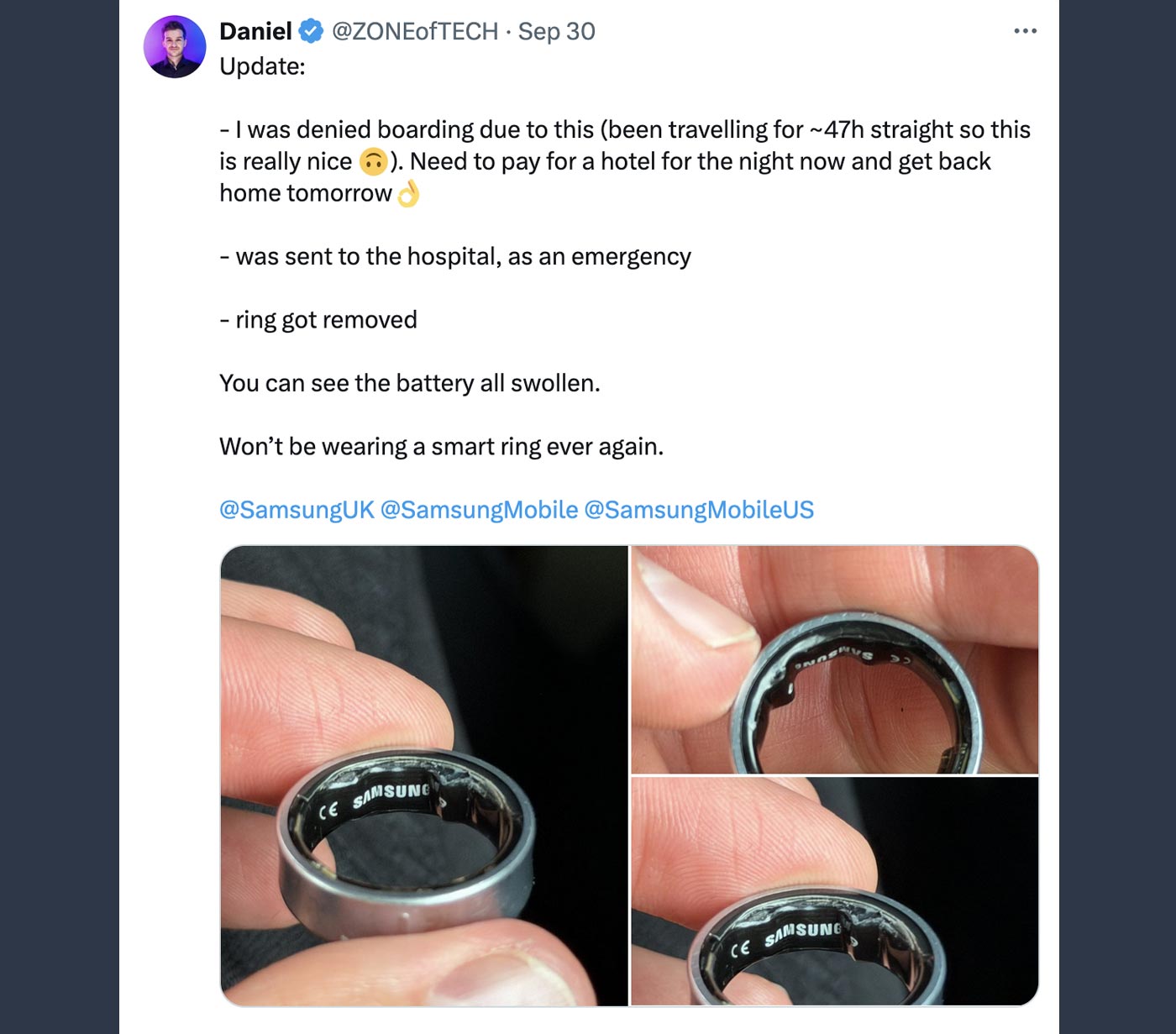
To recap, YouTuber Daniel Rotar of Zone of Tech found himself with his Galaxy Ring locked to his finger as he was preparing to board a plane. He needed to go to the hospital to have the ring removed by medical professionals. Here we have a device that, when it suffers from battery swelling, cannot simply be placed in a safe spot and quickly returned like a phone – instead, it naturally renders the user unable to immediately remove it from their skin without outside assistance. I showed the initial tweet to several people I know and the average reaction was shock and horror at the concept. As I stated above, when batteries swell it can occasionally mean they are ready to catch on fire. I don’t know why I didn’t consider this issue the moment I saw a Galaxy Ring – I had all the knowledge and the logic train is very simple, but it just didn’t occur to me. I suppose that’s partly down to me not being interested in the product – I already wear a smartwatch, another device easily removed in cases of faulty battery. But now, I can’t help thinking of someone finding that they can’t remove their Ring, only for it to grow to an unbearable temperature and catch on fire. “The sound of screams and sizzling flesh” is not a common phrase in a tech article, and yet here we are – it’s like something out of Final Destination. Rotar notes above that he “won’t be wearing a smart ring ever again”, and, while this may not mean much when I wasn’t going to buy one in the first place, I’m right there with him.
Samsung’s Reaction, And Mine
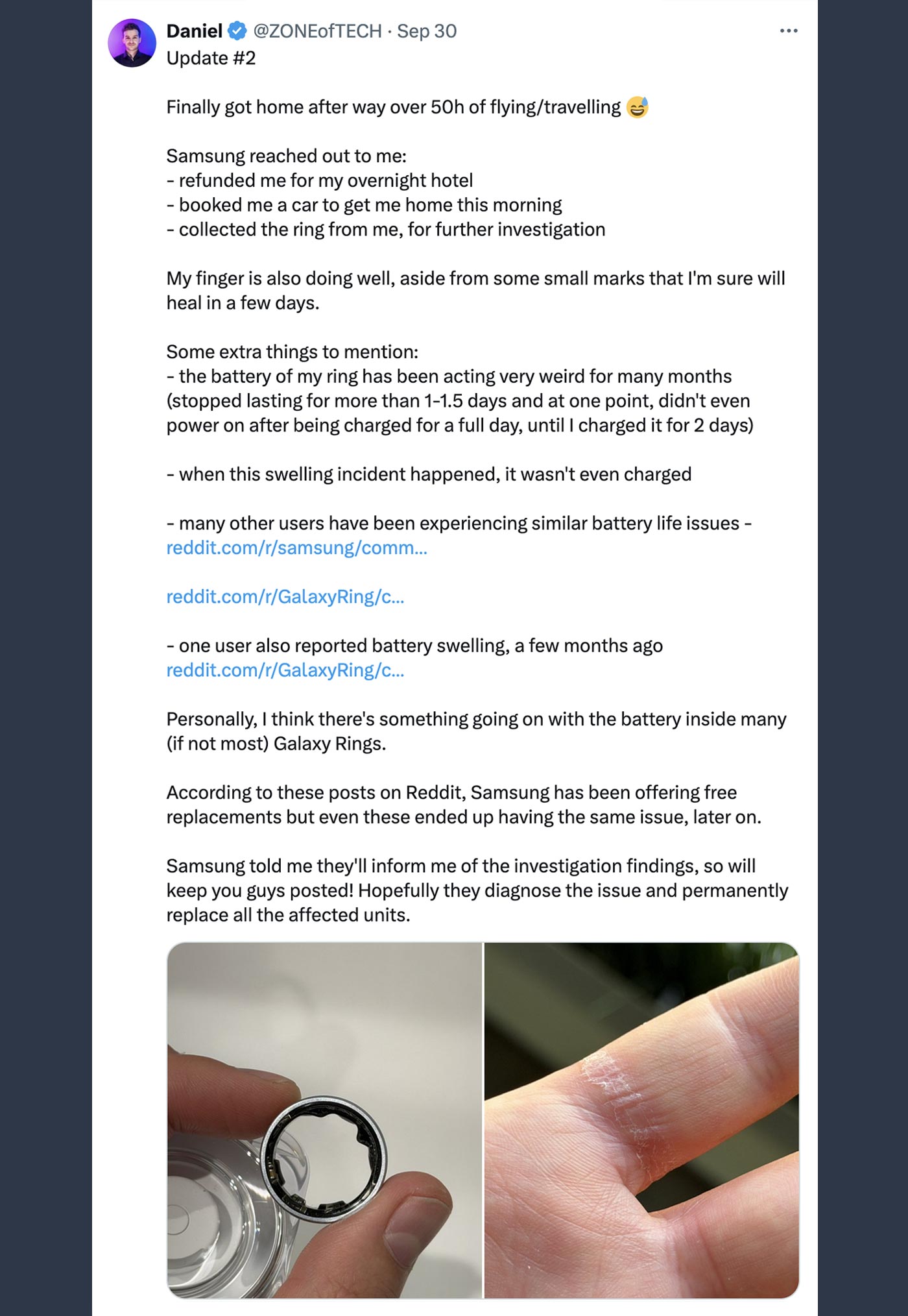
Zotar’s third tweet contains several points about Samsung’s contact of him, the promises of conducting an investigation, and online claims of similar issues followed by replacements that then continued to exhibit problems. An investigation into these incidents is obviously positive but also the absolute bare minimum, and frankly I can’t see this leading anywhere good. I absolutely expect a recall of the Galaxy Rings to be announced at some point soon, but it feels like this goes beyond just that. There have been countless product recalls before, sometimes brief ones to correct a minor fault in a device, and sometimes ones that are semi-permanent – the Galaxy Note 7 never went on sale again, but it was replaced within a year by the improved Note 8 and life went on. But a problem like what Zotar experienced feels less like “Our product has an issue that we need to correct in the next model” and more like “Our product was always fundamentally flawed from the start, right down to the most basic conceptual level”. The very idea of a “smart ring” – a wearable ring with a lithin-ion battery – is one that will eventually lead to the nightmarish horror movie scenario I described above, and you only need that to happen once for it to spread across the globe like wildfire and taint your product forever. So, is there any way to fix this?
Potential Solutions
Well, Samsung could design a Galaxy Ring 2 with some kind of clasp for easier removal, but I see a few issues with this. The clasp itself could fail, especially under the physical pressures of a swollen battery incident. It would make the Ring more cumbersome and difficult to wear. It would make it more obviously a Galaxy Ring – one of the main points of the Ring is to appear classy, subtle and largely like a normal ring, offering wearable tech functions for the consumer who doesn’t want to be seen wearing tech. And, most likely, it would serve as a constant reminder of the danger inherent to the Ring (the Theme of the One Ring intensifies).
However, there may be another, future solution. Recently I was watching an Undecided With Matt Ferrell video that I’ve linked above, which covers recent claims by Contemporary Amperex Technology Co., Limited (CATL) that they have sodium-ion batteries in mass production, for a price of US10 for evey kilowatt-hour – a shocking drop from the average $115 per kwh in current lithium-ion batteries, itself down from $1415 per kwh only sixteen years ago. What really caught my eye though is that sodium-ion batteries, while worse than lithium-ion in terms of energy storage number of charge cycle, are tremendously safer. The above issues of swelling, fire, explosions, etc. in lithium-ion batteries are a result of deep discharge, something that just doesn’t really apply to sodium-ion. Given this, sodium-ion struck me as a possible saviour of the smart ring concept. The CATL Naxtra batteries detailed in the Undecided video boast impressive improvements to energy storage and charge cycle counts, as well. That’s not to say that the Naxtras demonstrate an immediate fix, though. They are designed for electric vehicles – so on practically the complete opposite end of the size spectrum to a tiny Galaxy Ring battery – and I don’t know what would be involved in shrinking them down to such a degree. They still have lower energy storage than current lithium-ion, meaning that you’d probably have to charge a sodium-ion Ring on the daily. But should CATL’s claims turn out to be accurate, Samsung may have an eventual path to creating truly safe Galaxy Rings that will never attempt to mimic medieval torture implements – and to hiring Jared Padalecki and Jensen Ackles to make “salt ring” jokes in the marketing.
Conclusions
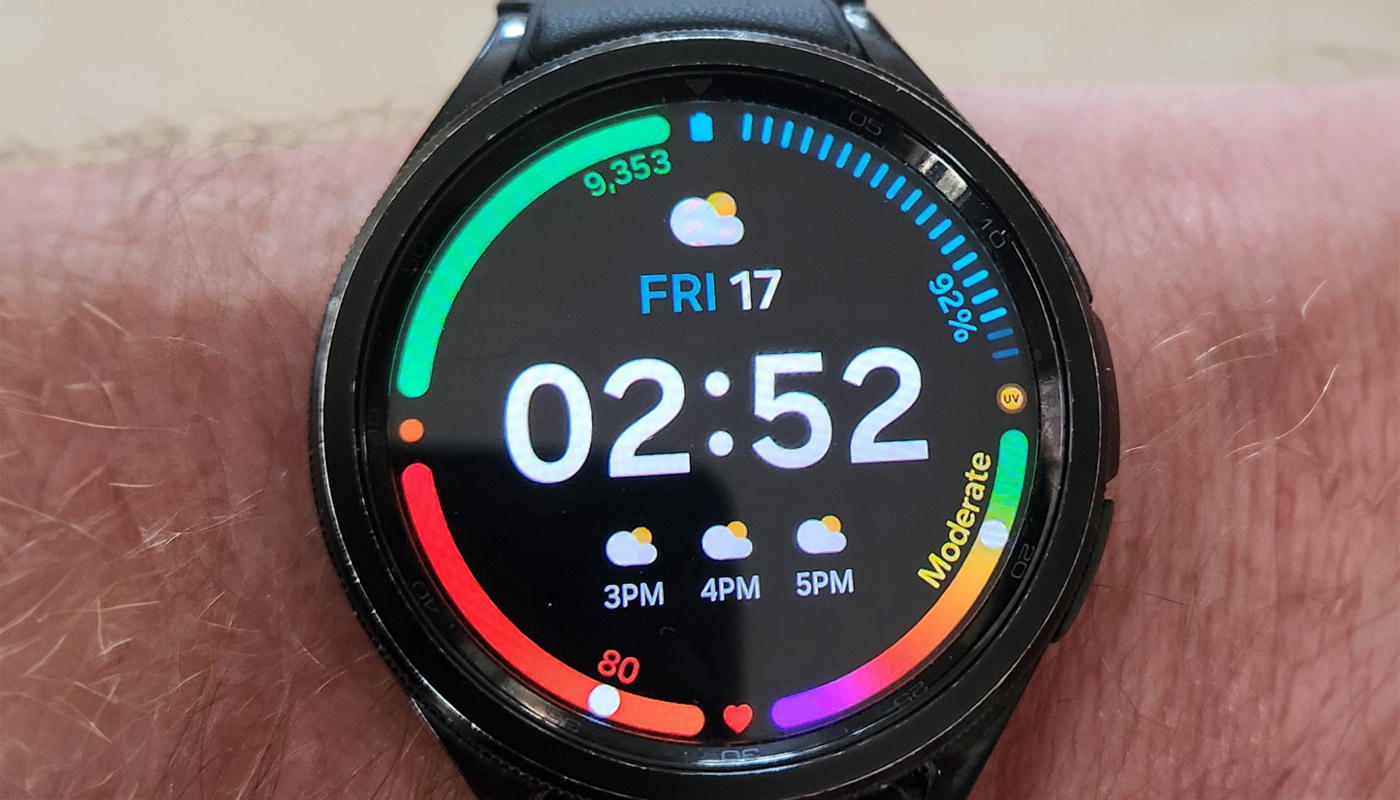
This feels like a safer way to get your health and fitness tracking metrics – for now, anyway.
I’d rather the smart ring concept not vanish forever. While I’m not personally interested in it as I find my fully display-equipped Galaxy Watch 6 Classic extremely useful, I completely get the desire to combine health and fitness tracking with wearing regular mechanical watches. As such I do hope that some of what I’ve laid out here comes to fruition. Sodium-ion batteries seem to have massive potential in terms of affordability, safety and sustainability (sodium being FAR more common than lithium), and would be a perfect fit for these rings – at least in the sense that they would make them feasible in the eyes of anyone who follows the Zone of Tech Twitter account. I’m excited to see what they manage more immediately in electric vehicles as well – seeing alreadyaffordable EVs drop in price by thousands of dollars due to cheaper batteries would be quite spectacular. Be well, and avoid smart rings – but only for now.